
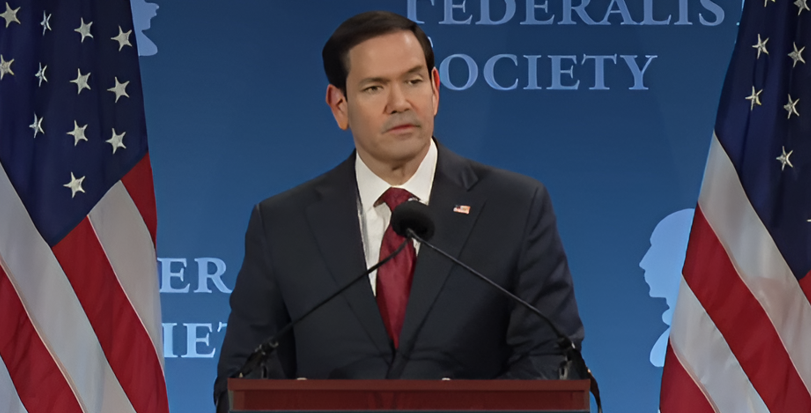
Marco Rubio Defends US Military Actions and Criticizes International Criminal Court
US Secretary of State Marco Rubio has strongly defended the Trump administration's foreign policy, arguing that the United States must protect its national security interests without allowing international organizations to control its decisions. In a major foreign policy address, Rubio criticized the International Criminal Court (ICC), questioned its authority over American actions, and explained why Washington considers Iran a major security threat.
During his remarks, Rubio also compared the leadership of North Korea and Iran, saying the two governments have very different goals. He argued that North Korean leader Kim Jong Un is mainly focused on keeping his government in power, while Iran's leadership follows a revolutionary ideology that seeks to spread its influence beyond the country's borders.
Rubio acknowledged that the conflict with Iran is unpopular among some Americans. However, he defended the administration's position, pointing to Iran's support for armed groups, its actions across the Middle East, and its treatment of people inside the country. He also warned that allowing Iran to develop nuclear weapons could create a serious danger for the United States and its allies.
Rubio Explains the Difference Between North Korea and Iran
One of the main points in Rubio's speech was his comparison between North Korea and Iran. He explained that Washington sees the motivations of these two governments differently.
According to Rubio, North Korean leader Kim Jong Un is primarily interested in keeping his government in power. He argued that Pyongyang is not mainly trying to conquer neighboring countries such as Japan or China. Instead, its nuclear weapons and military strength are intended to protect the existing government from outside threats.
This means that North Korea's behavior can be understood through traditional military deterrence. In simple terms, the country wants to make sure that other nations think twice before attacking it.
Rubio presented Iran as a different kind of challenge. He argued that the Iranian leadership is guided by a religious and revolutionary ideology that goes beyond protecting its own government.
He said Iran's ruling religious establishment wants to spread its influence outside the country and has supported armed groups in different parts of the Middle East. Washington has repeatedly criticized Tehran for providing financial, military, and political support to groups that the United States considers threats to regional security.
Rubio believes this makes Iran more dangerous than a government that is mainly focused on protecting itself. He warned that Iran's nuclear ambitions could become an even greater threat if the country obtained nuclear weapons.
Rubio Defends the US Position Against Iran
Rubio also defended the Trump administration's hardline approach toward Tehran, despite acknowledging that the conflict with Iran is not popular with many Americans.
He pointed to the Iranian government's treatment of its own people, including the use of force against protesters and restrictions on political freedoms. He argued that a government willing to use extreme violence against its own population should not be trusted with nuclear weapons.
Iran's nuclear programme has remained a major source of tension between Tehran and Washington for many years. The United States has repeatedly raised concerns that Iran could use its nuclear capabilities to develop weapons, while the Iranian government has maintained that its nuclear programme is intended for peaceful purposes.
Rubio's position reflects the Trump administration's wider approach to Iran, which focuses on limiting Tehran's military capabilities, reducing its regional influence, and preventing it from obtaining nuclear weapons.
However, the issue remains highly controversial. Supporters of a tougher US policy argue that strong action is necessary to prevent future threats. Critics warn that military pressure could increase regional instability and make diplomatic solutions more difficult.
Rubio Rejects International Criminal Court Criticism
Another major part of Rubio's speech focused on the International Criminal Court and its criticism of American military actions.
Rubio strongly rejected the court's authority to judge US decisions. He argued that international legal institutions should not have the power to restrict America's ability to defend itself or make decisions about national security.
He also criticized accusations directed at the Trump administration over US military operations, including strikes against suspected drug-smuggling boats in the Caribbean.
The ICC has faced criticism from the Trump administration over its investigations and actions involving different countries. Washington has long opposed the court's authority over American citizens, as the United States is not a member of the Rome Statute that established the ICC.
Rubio described the court as illegitimate and made clear that the United States would not accept foreign legal decisions that it believes threaten its national interests.
During his remarks, he referred to the ancient Roman general Pompey and used a historical message about the relationship between law and military power. His point was that the United States should not allow international legal institutions to control its actions through threats or legal orders.
His comments highlight the growing disagreement between Washington and international organizations over the limits of national power and the role of international law.
Rubio Defends American Power and National Interests
Beyond Iran and the ICC, Rubio used his speech to explain his wider view of America's role in the world.
He described the United States as a country built through exploration, expansion, hard work, and the ability to overcome major challenges. He argued that America's history shows the importance of ambition and national strength.
Rubio also criticized political ideologies such as Marxism, saying that their influence continues in parts of the world even after the collapse of the Soviet Union.
He suggested that powerful countries should not abandon their ambitions or allow international pressure to prevent them from protecting their interests.
His comments reflect a foreign policy approach that places national sovereignty, military strength, and American influence at the center of international relations.
What Rubio's Remarks Mean for US Foreign Policy
Rubio's speech provides a clear picture of the Trump administration's approach to international security. It shows a willingness to use American military and political power while rejecting outside criticism that Washington believes could limit its freedom to act.
His comments on Iran also show that preventing Tehran from obtaining nuclear weapons remains a major US priority. At the same time, his criticism of the ICC suggests that disagreements between Washington and international legal institutions are likely to continue.
For countries in the Middle East, the US position on Iran could have important consequences for regional security. Any further military escalation or change in Washington's policy could affect diplomatic relations, energy markets, and security arrangements across the region.
Overall, Rubio's message was that the United States intends to maintain its global influence, defend its national interests, and take a strong position against governments it considers major security threats.
Source: Fyrim analysis based on public remarks by US Secretary of State Marco Rubio.